

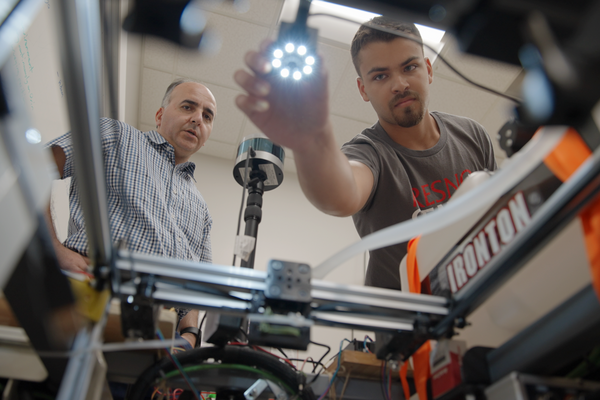
California State University, Fresno, celebrated the launch of a new program this fall called Finish in Five, which allows students to earn both a bachelor’s and master’s degree within five years. University leaders were eager to offer students at the Central Valley campus—which serves large populations of first-generation and low-income students, many the children of local farmworkers—a streamlined pathway to high-demand STEM fields in an economically distressed region.
But less than a month later, the program’s funding, which came from a Hispanic-serving institution grant, abruptly ended. The Education Department stopped awarding grants for HSIs and many other minority-serving institutions last month, claiming the federal programs amounted to “discrimination.” Officials argued the programs are “unconstitutional” because they require institutions to enroll certain percentages of students from specific racial or ethnic backgrounds, among other criteria.
Saúl Jiménez-Sandoval, president of Fresno State, said he doesn’t know what’s going to happen to the Finish in Five program now that the money is gone. In the past, the campus relied on about $5 million annually in HSI funding, which fueled a wide range of student supports and programs. The university was also expecting to receive $250,000 this fiscal year as an Asian American and Native American Pacific Islander–serving institution.
“In the grander scheme of things, most of the innovative programs that we have at Fresno State that further student success and graduation rates started with an HSI grant or with an MSI grant,” Jiménez-Sandoval said.
Similar stories are playing out across the California State University system. Hispanic students account for almost half of the system’s more than 450,000 students. Out of the CSU’s 22 campuses, 21 are Hispanic-serving institutions, meaning they enroll at least 25 percent Hispanic students and at least half low-income students. In addition, 11 are AANAPISIs, which have the same low-income student threshold and enroll at least 10 percent Asian and Pacific Islander students. CSU officials estimate ED’s axing of the grant programs leaves the system $43 million short on funds it expected for the 2025–26 fiscal year.
CSU chancellor Mildred García called the move “deeply troubling.”
“This action will have an immediate impact and irreparable harm to our entire community,” García said in a statement. “Without this funding, students will lose the critical support they need to succeed in the classroom, complete their degrees on time, and achieve social mobility for themselves and their families.”
Potential for ‘Great Devastation’
The sudden loss of funding caught system and campus leaders off guard.
Jeff Cullen, CSU’s assistant vice chancellor for federal relations, said he knew the HSI program was at risk when the state of Tennessee and the advocacy group Students for Fair Admissions sued the Education Department in June over such programs, questioning their constitutionality. But he expected the case to wind its way through the courts. He said ED’s swift decision to end the grant programs robbed campuses of time to prepare or fight on MSIs’ behalf. Cullen also pointed out that CSU campuses qualify as HSIs because of the demographics of their surrounding communities—not because they rely on affirmative action in admissions, one of the issues raised in the lawsuit; California banned affirmative action in 1996.
“Canceling grants midcycle and right in the middle of the semester creates unprecedented confusion and chaos,” Cullen said. “Our central goal is student success and getting students across the stage with a degree in hand. And this just continually undermines those efforts to do that.”
Meanwhile, CSU has no way to make up for the full extent of the funding losses, said Dilcie Perez, the system’s deputy vice chancellor of academic and student affairs. She called the abrupt end of MSI grants a “triple blow” at a time when the system’s campuses are already facing a $144 million cut in state support. The system also has only $760 million in reserves, a meager emergency fund compared to the endowments of wealthier institutions. She expects campus leaders will have to make painful choices, including cutting faculty and staff positions, to make the numbers work.
“I think the reality is we don’t know the magnitude yet,” Perez said, “but what we know is … we have folks who have lost positions, we have students who have lost support services, and that is not OK. What I know to be true is that no one campus can completely replace any of the funding that they lost.”
Jiménez-Sandoval, of Fresno State, said because of state-level cuts, he’s had to scrape together funds for “the basics,” leaving the university to rely on HSI funding to afford efforts to boost retention and graduation rates. More than 60 percent of Fresno State’s students are Latino, and about 65 percent qualify for Pell Grants and are the first in their families to attend college; many of them “need an extra little push in order to support them through their college career,” he said.
Despite some success with fundraising, he doesn’t believe philanthropy will ever make up for the missing funds.
The HSI program “is systemic and comprehensive in its support, and likewise, it is systemic and comprehensive in the tragic hit that we are taking right now,” he said.
Ronald S. Rochon, president of California State University, Fullerton, said he’s reaching out to alumni, donors and industry leaders in the hopes of keeping programs previously supported by HSI funding alive.
The end of HSI grants cost the campus at least $4.2 million, he said, endangering a range of student services. For example, money evaporated for the university’s Establishing Roots to Grow STEMs program, which offers peer mentoring and other supports to math and science majors, as well as the Fullerton ASPIRE program, which aims to improve graduation and retention rates for underserved students, including first-generation and community college transfer students.
Rochon plans to “fight hard” to preserve such programs. He emphasized that the university’s student success goals aren’t going to change, despite the losses. But he also pleaded with policymakers to “reconsider.”
While 54 percent of CSUF’s more than 45,000 students are Hispanic, “this is not just impacting students who identify as Hispanic,” Rochon stressed. “This impacts our entire campus community.” Some of these losses risk bringing “great devastation to our student body.”
Perez worries that the full effects of the funding losses on CSU students won’t be clear for years. She expects the sudden end of MSI funding will get in the way of the system’s long-term goals for students, including increasing graduation rates.
“More likely than not, there will be students who are not able to hit the finish line in the same time frame as they would have with this support and with this funding,” Perez said. CSU leaders are scrambling to figure out “how do we mitigate that as much as possible, because we’re not OK with students not crossing the finish line.”
