

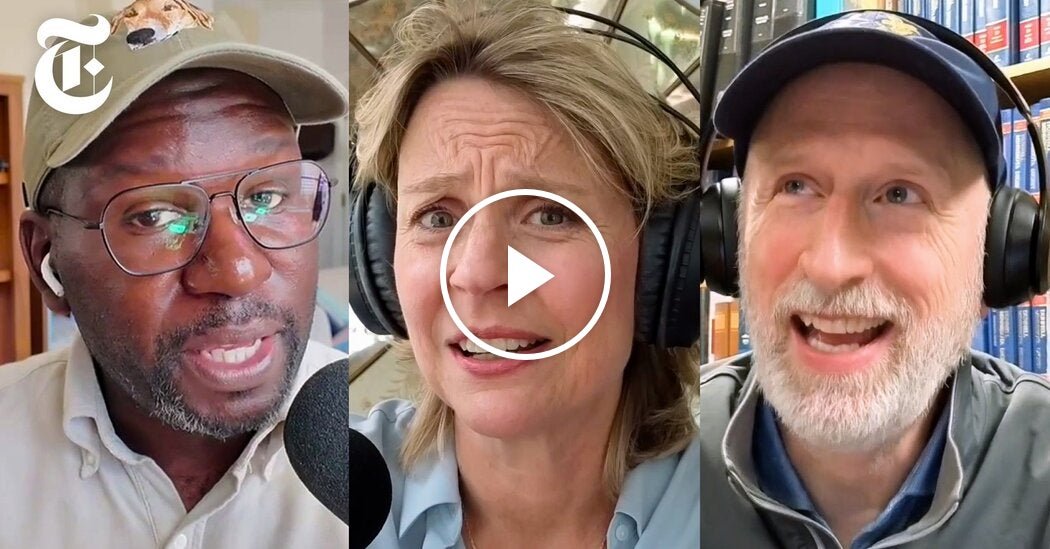
I think that Jamelle and I are locked in this intense competition as to who can quote more of the founders in our pieces. I’m loving that. I’m loving that. I’m glad you recognize it, David. I feel like people don’t recognize my founder obsession, but I’m glad you see it. Oh, no, I love it. Last week, David, you said Republicans and the right had a decision to make that after the Charlie Kirk killing, there was a fork in the road. They could go high or they could go low. And it looks like this week we found out which way they’re headed. So you have the crazies on the far left who are saying, oh, Stephen Miller and JD Vance, they’re going to go after constitutionally protected speech. No, no, no, we’re going to go after the Ngo network that foments facilitates and engages in violence. There’s free speech and then there’s hate speech. And there is no place, especially now, especially after what happened to Charlie in our society, the radicals on the left are the problem, and they’re vicious and they’re horrible and they’re politically savvy. So I want to dig into the free speech of it all, both legally and then culturally, especially with all the high profile firings and other punishments we’ve seen. But let’s start with the law and the Justice Department’s take on this situation. David, we heard attorney General Pam Bondi there, who got some backlash this week for her extremely creative interpretation of the First Amendment. Let me get your thoughts on the head of the DOJ going after free speech. So, Michelle, this was very interesting and very indicative of this moment in American history, because you had Pam Bondi come out and say there’s free speech and then there’s hate speech, which spoiler alert that right there is wrong. That right there is wrong. For decades and decades, it has been very clear that you cannot ban punish speech because you have deemed its content hateful. This goes back to a case called R.A.V. v. St. Paul. There’s a strong echoes of that and cases for decades beforehand. So right there she was completely wrong. Now, the immediate reaction to it, and in a weird way, was kind of heartening. You saw people from all over the political spectrum, including MAGA voices, saying, no, Pam Bondi, that is not right. You need to retract that. And so what does she do. She goes and she walks it back. Axios reported that she said, no, no, we’re not going to prosecute people for hateful speech. But nobody told Donald Trump. So Donald Trump, who’s her actual boss is asked about this hate speech issue by ABC’S Jonathan Karl. And he says in response to Jonathan Karl well that Bondi would quote probably go after people like you. Jonathan Karl of ABC because quote, you have a lot of hate in your heart unquote. And then he brags about collecting a $16 million settlement from ABC, which this gets more ominous as the moments ticked by for a form of hate speech. And so did you have the same reaction across the political spectrum against Donald Trump when he raises this hate speech issue. No no. Because in the MAGA verse, there’s a permission structure for going after an underling who is deemed to have failed Trump. There is not the same permission structure for going after Trump. And then, just hours after all of this unfolds, you see the FCC commissioner, Brendan Carr, going after Jimmy Kimmel, ABC News late night host for. And look, let’s just say it. What Kimmel was wrong or I’ll say he was half wrong. This is what Kimmel said. We hit some new lows over the weekend, with the MAGA gang desperately trying to characterize this kid who murdered Charlie Kirk as anything other than one of them and doing everything they can to score political points from it. The best evidence does not suggest that this guy, this shooter, was a member of the MAGA gang. But it is true that there’s a lot of point scoring going on, especially in the realm of free speech. And so Brendan Carr, the head of the FCC, threatens ABC. And next thing hours after that, ABC yanks Jimmy Kimmel off the air indefinitely. And so what are we looking at here. What we’re looking at is a situation where the response from the administration is vengeful. It’s punitive. It’s far outpacing any evidence in the case. We’ve not seen any evidence that this shooter was connected to anybody, much less a network of NGOs or other left wing organizations. And so what you’re seeing here is a pretext for a remarkable crackdown. And honestly, guys, I feel like we’re in the most dangerous point for free speech in America in my lifetime. And I don’t think it’s close at all. I want to dig into that more. But first, Jamelle, I want to get I want to get your thoughts on all of this. It’s just a lot to process. There’s nothing David said that I disagree with. I think his account of this is right on the money. The best way I can I think I can put this is that these people, the administration, the people eagerly trying to use Kirk’s death to impose, basically state directed speech restrictions who are threatening to go after freedom of assembly. This is when you’re threatening. We’re going to use the state to go after NGOs. We’re going to use this to go after organizations that do activist work. Like you’re threatening freedom of association. This, to me, is just like these people hate your freedom. Like, I don’t know what else to say. They hate the fact that you can talk back to them. They hate the fact that you can organize against them. They hate the fact that they cannot control what you say and think and do. I watched Vice President Vance, guest host Charlie Kirk’s show, and I have to say, as a bit of an aside, it’s really strange to have a government of podcasters. I know we were all in front of mics right now, but the president loves to go on podcasts. The vice president, if you watched the video feed, it didn’t identify him as the vice president and identified him as a close friend of Charlie Kirk, also a guest podcaster. The FBI director is a podcaster. Like everyone’s a podcaster. And it’s very weird. Charlie Kirk, podcaster. And it’s like, this is government by for and of podcasters. Anyway, that’s inside the I watched this JD Vance tirade, the screed, and its him fabricating and making up and I would say, lying direct to camera about the reality of the situation, about the realities of political violence and everything. And threatening Americans kind of basic fundamental rights to speak freely, basic fundamental rights to associate with whom they please to engage in political activity as they please. And I just find I find it remarkable. I also think that they’re very much getting ahead of themselves, I think on the MAGA. And certainly the image the administration wants to portray is that Kirk was this figure beloved by tens of millions of Americans. But in point of fact, although he had a large audience and it was influential, this was relative to the entire population of the country, pretty narrow. talking to my parents after the event last week, they didn’t know who Charlie Kirk was. They’re well educated, engaged people. Had no idea who he was. And many, many, many, many, many millions of Americans had no idea who this guy was. He was not at the head of any kind of social movement. He was not some movement leader. He was a media personality, a popular one within a certain segment, but nothing more, nothing less. And the administration attempting to turn this slain media personality into a kind of martyr for the country, some state sanctioned saint, and then using that to go after freedoms that people in this country take for granted. Americans take for granted. Their right to talk crap about other people to say that the president sucks, right. Like, that’s something Americans take very seriously. In fact, their right to just say what they please. This to me feels like them, the administration, its allies, attempting to impose something for which there is no real popular support. And I do wonder if we are not anticipating a real backlash that’s going to come in a strong way. So, Jamelle, you are always more optimistic about the coming backlash than I am. David, this isn’t optimism. This is just look, I think when we talk backlash in this moment, we have to talk about what does backlash mean. Because really, almost at no point in the last 10 years has Trump been a majority popular figure with a majority of Americans. But at this point, I think we’ve learned that you’re not going to see something like in the absence of maybe some catastrophic economic meltdown, you’re not going to see anything like the kind of low approval ratings that you saw for George W. Bush, say at the end of his second term that he has a higher floor than most politicians because of the dedication of that Republican base, however. However, the biggest issue in confronting Trump has always been that 60 percent of America never really was fully United on getting rid of Trump. They may not have liked him some percentage of that. They may not have liked him, but some of them were saying, I’m going to vote for him anyway because I don’t like the present conditions. I don’t like inflation. Et cetera. Et cetera. The key to ending Trumpism isn’t necessarily, and people need to get out of their heads, this idea that this is the thing that will fracture his base and instead put in your head, is this the thing that could finally unite his opposition. Because the uniting of the opposition to Trump would mean a 60/40 arrangement in this country. Not an evenly divided, not a closely divided. And so that is to me the question, the question isn’t, is this one thing or any number of things going to fracture Trump and fracture Trump’s base. It is this one thing or any combination of things going to unite the majority of Americans who are dissatisfied with Trump. And this is where I think their overreach comes in. And can I just to add to that, jump back in really quickly. I think it’s important to recognize that most people who aren’t particularly plugged in to politics, I think for most of the year, have not thought of this as any different than a regular presidential administration. They don’t like it. They don’t like the cuts. They don’t like a lot of the stuff they see, they don’t like the ICE raids or what have you, but they don’t think of it as different than something that came before. But if you have the government, if you have the state, the administration saying your favorite late night comedian can’t be on air anymore because he’s guilty of speaking ill of my political allies. That’s the kind of thing that does a filter down to regular non-political, apolitical people. It may begin to show them that oh, this is actually different. This is not just another Republican administration. This is something that is going after things that I rights, that I take for granted that I really value. And nothing’s automatic here. There’s still politics still needs to be done right. Like a political opposition still needs to take these raw materials and turn them into narratives that help people understand what is happening. But the raw materials are there, the materials to show ordinary Americans that the character of this government is not what you think it is, and is threatening your basic rights as Americans. That message can be crashed together and it just depends on an opposition to do it. All right. So that speaks to a question I wanted to ask both of you, which is that O.K, we have this moment I think Trump’s the Trump administration is working as hard as it can to make the Republican Party the party against free speech, the party of cracking down on your political critics. But Americans are being told we’re going to crack down on hateful speech, vile speech that is causing political violence. So even folks who philosophically like the idea of free speech. Is this something that’s going to rally them really. And again, we’re back to that question of what is really going to move people. And in the last several years, it has been the right that has been fired up about free speech, not the left. Like this has not been a crusading point for the left or even the center. So I mean, how optimistic are that 60 percent David’s talking about is going to look at this as a major issue for them to push back on. I’m just not that I’m just not that optimistic. Oh, I don’t think this alone. I mean, look at it this way. It’s a cumulative effect. It’s brick by brick rather than any one key moment. Because once again, if there was any such thing as one key moment, doing it January 6 is like a much bigger deal than any of this. But, Michelle, you hit on something very important. And that is how the right is very good at keeping the troops together. You could have 100 Democratic politicians say, all of the right things from Obama all the way through expressing lament and grief at Charlie Kirk’s assassination, you could have all of the mainstream media, even you could have the nation. Or was it Jacobin magazine editorialized against the Charlie Kirk murder, this Jacobin that’s not mainstream. That’s left. And then there’s a teacher in Portland who gets on TikTok and celebrates it, and they’re look, this is what the left is doing. That’s what they are doing. That’s what they are. And so they’re very good at that. And that rallies the base. For sure. And I don’t think anyone has found a way to penetrate that closed loop. But here’s the thing. If you’re looking at the 60 percent if on the one hand, you’re saying we’re taking out the worst of the worst and the NGOs and the terror networks, and that means Jimmy Kimmel, then you’re like, there’s a disconnect. I mean, if the next thing you had after this, we’re going after the bad people was singling out somebody who had done some horrific celebration of Charlie Kirk, who was a television personality. Just horrific celebration of the death that would land very differently than Jimmy Kimmel. One of the things that you’re seeing on the right is these guys are extremely hubristic right now. They think all of the wind is at their back. They think that they are the alphas of the culture right now. They are feeling their oats and they are overreaching at a level. And I agree with Jamelle. They are absolutely overreaching. But here’s what worries me is a way. Can you overreach so much that when you push so far into actual authoritarianism, it has a more does it have a more intimidating effect than it does a rallying effect. And it’s obvious to me that that’s what they’re heading towards. They’re trying to push all the way through normal American politics and get to a point where they feel like that they can dictate the terms of the debate through sheer retribution and intimidation and cow opponents into silence. And so I think that is literally the core theory of the case here, that they can just push through normal politics and achieve sweeping, permanent change through the raw exercise of power. I think that’s right. I think that’s absolutely the theory of change. And I think it’s mistaken in part because the theory of change in their theory of society is very top down. You see this whenever Christopher Rufo talks about this stuff. And he seems to have this idea that there’s some representative of liberals, of liberals, of liberalism that can offer terms of surrender. When Vance talks about going after NGOs earlier in the year, Elon Musk had similar words. We defunded or we destroyed USAID. We’ve done a blow to the left. What they believe is that liberal politics, liberalism, social justice, politics. All these beliefs are a top down phenomenon of elites that they don’t like. And so that if you get rid of if you go after George Soros, if you go after the Ford Foundation, if you go after USAID, if you go after television comedians, then people will stop believing this stuff. You will secure your victory. Because none of this is real. It’s all just top down. I happen to think that this is a bit of projection about the nature of their political movement, that it is quite top down. It is funded by secretive billionaires who can allow someone like Charlie Kirk to work out the kind of performance they’re doing and not really have to worry about earning money in any way that there’s this huge infrastructure of money and influence on the political right. That does do what I think they think happens on the political left. And I think that the weak point in this strategy is simply that the stuff that they hate flows organically up from the bottom right. And the reason why George Floyd became a cause for millions of Americans isn’t because a bunch of liberal elites in television studios were telling people have to care about George Floyd. This was an organic reaction of the society to something that many people felt was wrong, and their feelings that it was wrong is, in turn, a product of organic changes in the society. It’s a product of integration among people. It’s a product of scholars and historians doing their own work and their own thing, and that kind of slowly changing understandings of what American history is. It’s just a product of civil society and of Democratic life kind of happening spontaneously. And that’s not something you can control from the top down. Like successful authoritarians know this successful authoritarian movements, successful authoritarian countries know that they can’t actually control every thought of the people under them. All they can do is make it disadvantageous to express that, and then also make life good for enough people that no one cares all that much. Well, that’s certainly that certainly could be where the administration is headed. That could be where we’re going. I don’t think on the make things good enough for enough people so that they don’t care is like working out for them precisely because of the economic mismanagement. I think that’s another weak point of all of this. But I just want I just want to emphasize and you guys tell me. I’m optimistic. I’m not optimistic. I’m just like I’m always my question is always, well, how does this actually work. Practically like the mechanics of these things. How is this kind of consolidation supposed to work in practice. And if the theory of the case is that no one really believes in liberal values, no one really believes in values of equality and inclusion. If that’s your theory, then you’re going to be surprised when it turns out that, in fact, many tens of millions of Americans believe these things and believe them quite sincerely and are willing to act on those beliefs. There is about a 50 year unfolding Genesis of this belief that social change occurs top down. And part of it is rooted in a very important choice that the conservative American religious community made slowly at first and then more rapidly beginning about 40, 50 years ago. And that was as they looked at social changes around issues of sexuality and other issues. They determined that the way to intervene into the process of social change in America was going to be primarily political and not cultural. And you began to see emerging, and you see this throughout a American evangelicalism. Is this idea that really the ultimate way of achieving change, the real what really gets change is the attainment of power. And that then began to channel so much of religious activity in this country into the acquisition of power. There’s a show on Amazon Prime, shiny happy people, that has taken two seasons looking at two big religious movements in the US, one involving teens, one involving like homeschool parents, et cetera. And one thing that you see is a lot of these figures as they got more influential. Many, not all, but many of them is the culminating act of influence. They moved into politics. The cultural influence became merely the prelude for the real thing, which was politics. And so this began to imprint for a very long time, to the point where it is now just fully imbibed in much of many religious communities in the U.S., that the way to save the country is through the acquisition of power. That is the way to save the country. And so what is meant that is an inherently authoritarian impulse, because in the absence of your own power, what happens. You lose the country. And so that’s where we are. It is a theory of social, cultural, political, religious change that all culminates in the Oval Office. And that is an extraordinarily dangerous mindset. So I want to step slightly away from the legality. All of this. It’s like, Jamelle, you were bringing up the George Floyd protests. And what happened with in 2020 with Floyd was more in the cultural realm. We saw people fired for making comments considered racist or promoting violence. We’re talking about an announcer for the NBA’s Sacramento Kings, a Denver police officer, things like this, aside from the state intervention, which I think is the big distinction here, once you have the tools of government and you start using the tools of government to slap down and silence your political enemies. Culturally speaking, where does the parallel break down with the extreme speech policing and things like that happened. Or around the George Floyd stuff and what we’re looking at now just in terms of cultural backlash. I mean, I’m not actually sure you can separate the cultural stuff from the state stuff. Because so much of what we’ve witnessed over the last week is directly encouraged by government officials. It’s not on day one. Like last Wednesday, it was the President of the United States giving an Oval Office speech where he is threatening, threatening the political left, threatening liberals and creating this atmosphere of if you don’t feel about this the way we feel about this, we’re going to go after you. And that just continued to escalate. So I’m not actually sure you can make that separation that what this past week has been primarily, in my view, is the Trump administration using the organs of the federal government and using its allies, attempting to suppress what it views as unfriendly speech, what it views as a political opposition and wrongthink about a figure that it holds in high esteem. Like David earlier said that this was kind of the worst environment for free speech that he’s seen in his lifetime. And I was actually trying to think of what was comparable to this. And there’s basically two periods that are comparable to this, the first Red Scare and the second Red Scare. That’s it. That’s what this is. This has more in common with the red scares than it does with speech policing during the Floyd protest or cancel culture on universities or whatever, which full disclosure, I’ve always been kind of like I think of some of this as overblown. But what I do take very seriously is state suppression of speech. And this is what this is. I have long had the position that both in public and private life, we should have a default position to protecting speech, not just the government, which is mandated by the First Amendment to protect speech. But we as people and our private institutions and our private organizations should be broadly tolerant of even speech that we strongly disagree with. Now, that principle doesn’t mean that we have to bind private organizations to hire vile people. So, for example, there’s a big difference between somebody who received an enormous amount of hatred because, say, they didn’t put up a black square on their Instagram page during the George Floyd era and Roseanne Barr. Roseanne Barr, who just engaged in a blatant, just unbelievably racist statement, unequivocally racist statement. And ABC let her let her go. Now, critically, not because of government pressure. This was in Trump’s first term, but they let her go. And so which, by the way, led to one of the funniest tweets in history, which was she later blamed her meltdown on Ambien and Ambien, tweeted that racism is not a known side effect of Ambien, which is pretty good. But so I do think that there is a situation, there are lines where if you have an employee who’s dealing with the public and they posted something about Charlie Kirk, that’s gross. Like, I’m not going to mourn a dead white man. I don’t think that the employer has to keep that person employed. But I also think that the permission structure should be really pretty darn big, that we have a rebuttable presumption that we’re going to tolerate a wide range of speech. But in the public sphere, when it comes to the government, there isn’t that flexibility. They are bound by the First Amendment. And by the way last term, in a unanimous opinion by Justice Sotomayor, the Supreme Court articulated once again that government officials violate the Constitution when they coerce private organizations into suppressing free speech rights. And so there is a very broad and prohibition against the government that should be rigorously enforced, but that is where we are right now is essentially the President of the United States is now every bit as intolerant of speech as the most radicalized Oberlin undergrad, except he’s the President of the United States, and he’s employing all of the power of the state. And that is what makes this so much more alarming even than a wave of cancellation in private life. Yeah, I do take Jamelle’s point about it’s hard to separate it, and I think it goes well beyond just the immediate fallout from the Kirk assassination. I mean, it is important to note that Trump was threatening to go after George Soros organizations before this happened. This is not something that he has suddenly decided is necessary because of this. But also just when you’re looking at the universities that have dismissed staff in recent weeks, or the public school teachers who have been placed on leave. I mean, Trump and the administration have made clear that they have these places under a microscope. I mean, if I’m a university administrator, I’m freaking out that he’s coming for me like he’s coming for Harvard or anywhere else. So even if he hasn’t made direct threats yet, already we’re seeing a culture of intimidation by this administration that you better watch your back if you say anything that we don’t like. One thing I want to note, I want to note here is I don’t think you can separate this embrace of state sanctioned censorship from the illiberal tendencies that have I think, always been a part of the American right. And I’m using that, very specifically, not simply to refer to the conservative movement, but the reactionary right that’s been in the United States for quite some time. I mentioned the first Red Scare, which is obviously under Wilson, and the Second Red Scare under McCarthy. And there you see a lot of enthusiasm for the second Red Scare among the American. And these over the last 10 years or so, there has been this notion of a post liberalism of a conservatism that isn’t so concerned with liberal shibboleths, that is aiming towards the common good. And from my perspective, what we’re seeing is what that means in practice, to say that we have to orient things around the common good. It’s first, it’s whose common good where it’s apparently their common good and their common good is such that if what you want to express violates their intuitions or offends their sensibilities, then it’s not just that you get yelled at about it over the internet, but that the state itself comes to tells you to shut up, or else you’ll lose your job, you’ll lose your livelihood. And to my mind, this — all of this is just the natural consequence of a set of ideas that very explicitly reject the lowercase ‘l’ like liberal heritage of the United States, enshrined in the Bill of Rights. Expressed in the Declaration of Independence and the Gettysburg Address, expressed in FDR’s four freedoms. Like very basic things that Americans have taken for granted for a long time about what constitutes American freedom. And what Vance is saying is that no American identity is actually about this religio-cultural-ethnic identity. And if you believe things or say things that violate the standards of that construct we’ve created, then you forfeited your right to the freedoms you think you enjoy. It’s very radical stuff in the literal dictionary sense, and I would call it just frankly, un-American. Yeah let me just point out for a second, I think that Jamelle and I are locked in this intense competition as to who can quote more of the founders in our pieces. I’m loving that. I’m loving that. I am. I’m glad you recognize it, David. I feel like people don’t recognize my founder obsession, but I’m glad you see it. Oh, no, I love it, love it. I think we lead the league in quoting the anti-federalists as well, which that’s a particular brand of nerd pride. I’m just here wallowing in your nerd. This is what I’m here for, guys. But I’m going to make that the last word on this before we shift to our recommendations for the week. So what are you watching, listening, eating, reading, doing that you want to recommend David. You go first. So Michelle, I don’t want to brag, but I will never lead our listeners astray on my pop culture recommendations. So it’s a bold statement. You can just fast forward to this portion of the podcast. Because this is the meat right here. So I’m only two episodes in, but I cannot say enough good stuff about the new HBO crime. They have these prestige Sunday night dramas. It’s called “Task” and it is about an FBI ad hoc FBI task force formed to stop a group of home invaders who are invading the homes of biker owned by biker gangs and stash houses, drug houses. So it’s a kind of a what’s the opposite of a love triangle. A hate triangle, and with a twist at the end of the pilot that’s really, kind of shocking and gripping the performances are phenomenal. And so Yeah, I you’re welcome listeners. You’re welcome. You have not steered me wrong yet. So I’m going to go in with that one. Jamelle, what about you? Yesterday, the day before we recorded this, I had the real pleasure and honor to host a conversation with the historian Eric Foner, the emeritus historian, Eric Foner, Columbia University, about his newest book, “Our Fragile Freedoms.” And it’s kind of a collection of his a lot of reviews of other works of history. And it’s an interesting collection because in his reviews of history and in his reviews of history, basically covering reconstruction, the Civil War, slavery, Jim Crow, kind of the subjects that have consumed his own academic career. You both get a sense of his developing and evolving thoughts over the course of the 25 years or so that the book covers, but also you get a picture of what the practice of history, of academic history has looked like it has grown and changed and has become and is so fruitful and interesting over the last 25 years. And this is all to say that the book is a great read, because it’s a collection of essays, and few of the essays are longer than five or six pages. It’s a great book to just like the way I read is after dinner, I’ll read a little bit of something, and then I’ll set it down and do dishes or whatever. If you’re that kind of reader who can just read a couple pages, set it down and move on. This is great for that because you can read an essay, set it down, and then return to another one another time. So “Our Fragile Freedoms.” This sounds very promising. I’ll try this as well. O.K, I’m going in a different direction though, completely different direction. And I want to recommend this weird thing I do of the fall purge. This is basically like I need to go through the house and do things throw out the dead houseplants that didn’t survive when nobody would water them, throw away the gross chew toys and empty cans of bug spray or suntan lotion or whatever, and just clear the decks so that I can then go out and buy mums and just Usher in the fall season and just get into the spirit of it all. And then it makes me feel more organized because my life often feels extremely chaotic and not remotely organized. I like it, and it sounds like a lot of work, but I’m one of those weird people. Plus, I live with pack rats, so this is a bit of therapy for me as well. All right. And with that, I’m going to free you guys. Thank you so much for coming in. Oh, thank you so much, Michelle. Thanks, Michelle.

Subscribe to Updates
Get the latest creative news from FooBar about art, design and business.